
Every year, the Sindh Public Service Commission opens the door to some of the most respected government jobs in the province — lecturers, assistant directors, excise inspectors, section officers, and dozens of other posts across Sindh’s departments. And every year, thousands of well-qualified graduates apply. Yet only a small fraction of them clear the written test.
Here is the uncomfortable truth most aspirants learn too late: they don’t fail because they aren’t smart enough. They fail because their SPSC exam preparation had no real strategy. Random books, no plan, zero timed practice — and then disappointment on result day. This SPSC exam preparation guide fixes that. It walks you through the SPSC exam system, the syllabus, the paper pattern, the books worth your time, and a week-by-week plan you can actually follow, even if you are preparing alongside a job.
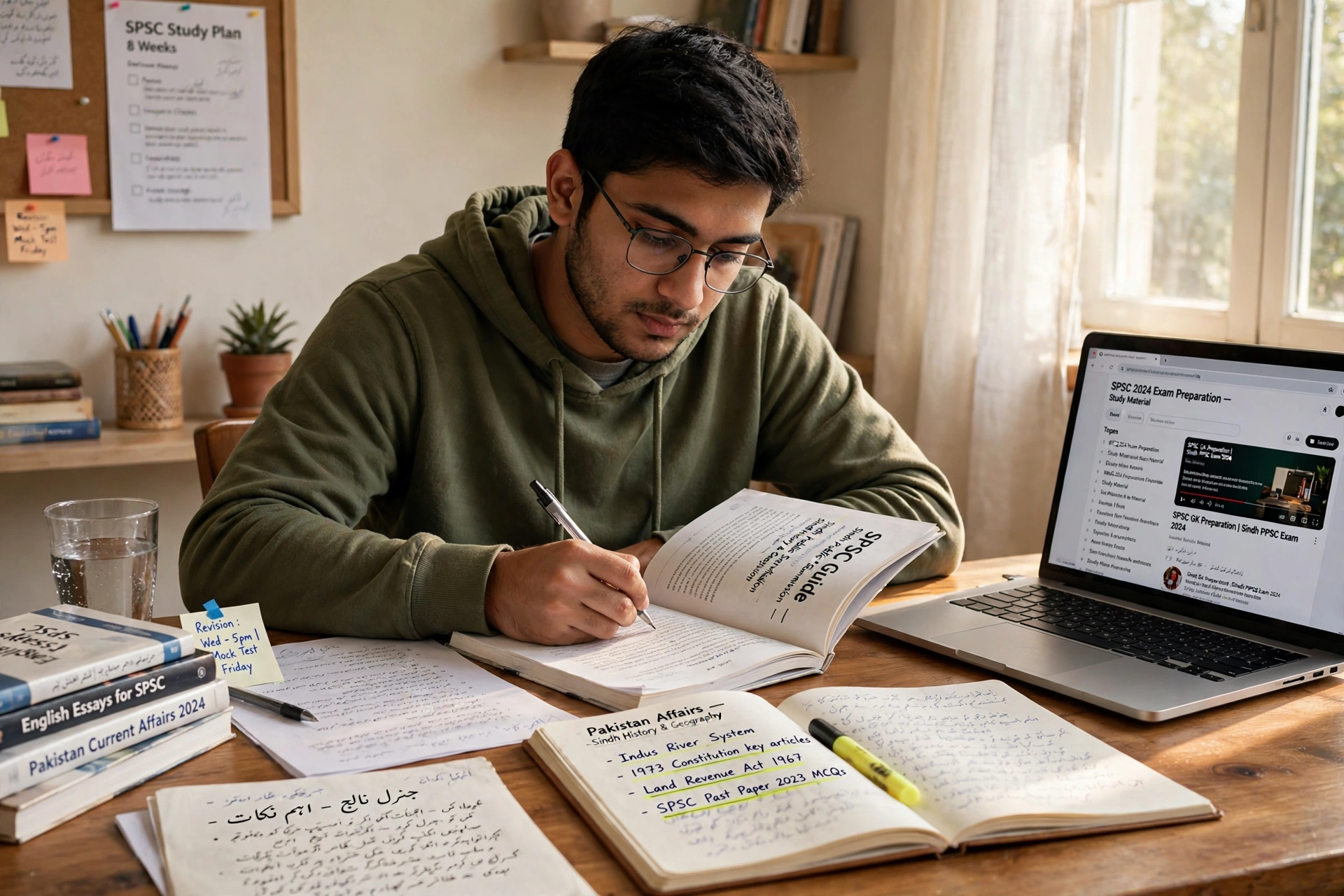
Table of Contents
How the SPSC Exam Actually Works
Before opening a single book, understand what you are preparing for. The Sindh Public Service Commission (SPSC) recruits for the Government of Sindh through consolidated advertisements published on its official website, spsc.gov.pk. Depending on the post, the selection process usually moves through these stages:
- Screening / MCQ test: For most departmental posts (BPS-16 and above), the first stage is a single multiple-choice paper. This is the make-or-break stage for the vast majority of candidates.
- Written (descriptive) examination: For the Combined Competitive Examination (CCE/PCS) and some specialist posts, candidates face written papers — compulsory subjects plus optional subjects of their choice.
- Interview (viva voce): Those who clear the written stage are called for an interview, where confidence, subject knowledge, and suitability for public service are assessed.
The golden rule: the advertisement for your specific post always mentions the test syllabus. Some candidates prepare for months and then discover — on test day — that the paper had a different composition than they assumed. Don’t be that candidate. Read the ad line by line before you plan anything.
SPSC Exam Syllabus — What You Really Need to Study
The SPSC syllabus is not one fixed document — it varies from post to post. But the patterns repeat enough that you can plan your SPSC exam preparation smartly. Here is how the syllabus usually breaks down.
For departmental MCQ posts (the most common type)
A typical SPSC screening test syllabus splits into two broad portions:
- English (often around 40% of the paper): Grammar and usage, vocabulary, synonyms and antonyms, idioms and phrases, one-word substitution, prepositions, fill in the blanks, active and passive voice, narration, analogies, and error correction.
- General Knowledge (often around 60% of the paper): Pakistan affairs, current affairs, everyday science, Islamiat, and basic computer/technological knowledge.
This 40/60 style split is seen in many SPSC departmental tests, though the exact weightage for your post is set by the syllabus attached to its advertisement. When in doubt, download the official syllabus for your post from the SPSC website and treat it as your study map.
For the Combined Competitive Examination (CCE/PCS)
The CCE follows a broader structure: a preliminary MCQ screening on general knowledge, current affairs, and English, followed by written papers divided into compulsory subjects (typically English essay and grammar, general knowledge and current affairs, Pakistan studies, Islamic studies or ethics, and the provincial language paper — Sindhi or Urdu) and optional subjects you choose from a list (international relations, sociology, political science, public administration, law, and others) based on your background. A psychological assessment and viva voce complete the process.
Understanding the SPSC Paper Pattern
Knowing the pattern changes how you approach SPSC exam preparation. Here is what the papers generally look like:
- MCQ screening tests: Usually 100 multiple-choice questions in a single paper, answered under a tight time limit. One mark per question is the standard; any negative marking or special instructions are announced in the test instructions — read them on the day, don’t assume.
- Written papers (CCE): Descriptive papers with essay-type and short questions, testing depth of understanding, expression, and analytical ability — not just memorization.
- Time pressure is real: In MCQ papers, most candidates don’t lose marks to hard questions. They lose them to the clock. Your preparation must include timed practice, not just reading.
If you are also eyeing federal posts, our FPSC test preparation guide breaks down that paper pattern in the same detail — the two exams share a lot of DNA, especially in the general knowledge portion.
Recommended Books for SPSC Exam Preparation
Walk into any bookstore in Karachi, Hyderabad, or Sukkur and you’ll drown in “SPSC preparation” books. Most of them are recycled MCQ dumps. Here is a cleaner approach to SPSC exam preparation: one solid book per subject, chosen for understanding, plus past papers for practice.
English
English carries heavy weightage, so treat it as a subject, not a side activity. A standard grammar book such as Wren & Martin’s High School English Grammar covers the grammar portion thoroughly. For vocabulary, idioms, and one-word substitution, use a competitive-exam vocabulary book and build a personal notebook of 10–15 new items a day. Publishers such as Dogar, Caravan, and JWT publish widely used competitive-exam MCQ books in Pakistan — pick one current edition and work through it completely rather than skimming three.
Pakistan Affairs and Current Affairs
For Pakistan affairs, any standard competitive-exam Pakistan studies book works — but current affairs is where papers are actually won and lost. Read a quality English newspaper daily (Dawn’s editorials are excellent for both current affairs and English). Follow a monthly current affairs magazine for compiled facts. Keep a running “current affairs diary”: one line per important event, dated. Before the test, this diary becomes your fastest revision tool.
Everyday Science
Everyday science in SPSC papers is school-level science tested cleverly. Revise science textbooks from classes 6 to 8 — they cover the bulk of it — then practise with a general science MCQ book. If you can explain a concept simply, you can answer its MCQ.
Islamiat
A dedicated Islamiat MCQ book for competitive exams is enough, focused on the standard areas: the life of the Holy Prophet (PBUH), the caliphs, pillars of Islam, important battles and dates, and the Quran. Short, factual, and highly scoring if revised regularly.
General Knowledge and Sindh-Specific Knowledge
A general knowledge compendium handles world GK. But here is an edge most candidates miss: Sindh-specific knowledge. SPSC papers regularly include questions on Sindh’s history, geography, culture, rivers, districts, and notable personalities. Our PPSC general knowledge preparation guide shares techniques for mastering the GK portion that apply equally to SPSC.
Sindhi / Urdu (provincial language paper)
For CCE candidates, the provincial language paper is often underestimated — and it can quietly decide your aggregate. Use a standard grammar book for the language you choose and practise past papers.
Optional subjects (CCE)
Choose optionals you have an academic background in, and study from degree-level textbooks — not guidebooks. Scoring in optionals comes from depth, and depth comes from real books.
Your Step-by-Step SPSC Exam Preparation Plan (8–12 Weeks)
You don’t need a year. You need 8 to 12 focused weeks. Here is an SPSC exam preparation plan that works for full-time aspirants and can be compressed for working candidates:
- Weeks 1–2 — Foundation: Download the official syllabus for your post. Map every topic to a book. Attempt one past paper cold, just to see where you stand. Don’t panic at the score — it’s a baseline, not a verdict.
- Weeks 3–6 — Subject-wise study: Cover one subject area at a time. Study a topic, then immediately solve 50–100 MCQs on it. Maintain a daily habit of 100 MCQs. Start your current affairs diary and newspaper routine from day one.
- Weeks 7–8 — Past papers and timed mocks: Solve the last 5 years of SPSC past papers for similar posts. Then take full-length timed mock tests every 2–3 days. Analyse every wrong answer — the analysis matters more than the score.
- Weeks 9–10 — Revision and current affairs catch-up: Revisit your notes and weak areas. Compile the last 6 months of current affairs. Practise English précis and grammar daily in short bursts.
- Weeks 11–12 — Final polish: Short revision cycles only. One mock every other day. Sleep properly. In the final week, revise formulas, dates, and your current affairs diary — don’t start any new book.
Working a job? Three to four focused hours a day on this same sequence still works — stretch the plan to 14–16 weeks and protect your study hours like appointments. Consistency beats intensity every single time.
Practical SPSC Exam Preparation Tips That Make a Real Difference
- Past papers are gold. SPSC repeats concepts, and sometimes near-identical questions, across years. Solving past papers teaches you the examiner’s mind — what they ask, how they phrase it, what they ignore.
- Write, don’t just read. Copying key facts by hand into your own notebook builds memory far better than highlighting someone else’s book. Your notes should be short enough to revise in a day.
- Master English grammar rules, not tricks. Most English MCQs test the same 30–40 rules repeatedly. Learn the rules properly once, and that portion becomes your safest scoring area.
- Revise on a schedule. Use simple spaced repetition: revise each topic after 1 day, then 7 days, then 30 days. Without this, you’ll forget 70% of what you studied within a month — that’s not pessimism, that’s how memory works.
- Practise under time pressure. Aim to attempt 100 MCQs in 80–90 minutes in your mocks, leaving a buffer for the real test’s pressure. Speed is a skill; train it.
- Stay current, daily. Fifteen minutes of headlines every morning, plus one editorial, covers the current affairs portion better than any last-month crash course.
- Attempt every question. Unless the test instructions specify negative marking, never leave a question blank — an educated guess always beats zero.
Common SPSC Exam Preparation Mistakes That Sink Aspirants
- Collecting books, finishing none. Ten half-read books lose to one fully-read book. Limit your sources.
- Memorizing without understanding. SPSC increasingly tests concepts, not just facts. If you can’t explain it, you don’t know it.
- Ignoring the official syllabus. Preparing “general GK” without checking what your specific post’s paper actually covers is the most expensive mistake on this list.
- Zero timed practice. Reading for three months and never sitting a timed mock is like training for a race by walking.
- Neglecting English. Candidates pour months into GK and treat English as “easy” — then lose the 40% portion that could have carried them.
- Cramming current affairs at the end. Current affairs is a daily habit, not a final-week panic.
- Studying in isolation. Discussing topics with a study partner or group exposes gaps you never knew you had. Even explaining a topic aloud to yourself works.
FAQs About SPSC Exam Preparation
Final Word
SPSC exam preparation is not about being a genius — it is about being systematic. Understand your post’s syllabus, choose a small set of good books, follow a timed plan, solve past papers relentlessly, and protect your English and current affairs portions. Thousands of candidates will apply for the same post as you. The ones who clear it are rarely the most talented in the room — they are the most prepared. Start today, stay consistent, and give yourself a real shot.
For more SPSC exam preparation resources, explore our FPSC test preparation guide and the PPSC general knowledge paper strategy — and always verify test details against the official SPSC website before you apply.

Choudhary Haseeb is the founder of NexHireX, a career guidance platform covering government and private-sector job opportunities in Pakistan and the Gulf. He publishes practical guides on job requirements, application steps, and deadlines to help job seekers make informed career decisions.